

|
Golliwogg.co.uk |

Golliwogg.co.uk
|
||||||||||
|
Golliwogs & Racism |
||||||||||
|
For the past four decades Europeans have debated whether the Golliwog is a lovable icon or a racist symbol. In the 1960s relations between Blacks and Whites in England were often characterised by conflict. This racial antagonism resulted from many factors, including: the arrival of increasing numbers of coloured immigrants; minorities' unwillingness to accommodate themselves to old patterns of racial and ethnic subordination; and, the fear among many Whites that England was losing its national character. British culture was also influenced by images - often brutal - of racial conflict occurring in the United States.
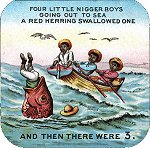
In many ways the campaign to ban Golliwogs was similar to the American campaign against Little Black Sambo. In both cases racial minorities and sympathetic Whites argued that these images demeaned Blacks and hurt the psyches of minority children. Civil rights organisations led both campaigns, and White civic and political leaders eventually joined the effort to ban the offensive caricatures. In the anti-Golliwog campaign, numerous British parliamentarians publicly lambasted the Golliwog image as racist, including, Tony Benn, Shirley Williams, and David Owen. The claim that Golliwogs are racist is supported by literary depictions by writers such as Enid Blyton. Unlike Florence Upton's, Blyton's Golliwogs were often rude, mischievous, elfin villains. In Blyton's book, "Here Comes Noddy Again", a Golliwog asks the hero for help, then steals his car. Blyton, one of the most prolific European writers, included the Golliwogs in many stories, but she only wrote three books primarily about Golliwogs: The Three Golliwogs (1944), The Proud Golliwog (1951), and The Golliwog Grumbled (1953). Her depictions of Golliwogs are, by contemporary standards, racially insensitive. An excerpt from The Three Golliwogs is illustrative: Once the three bold Golliwogs, Golly, Woggie, and Nigger, decided to go for a walk to Bumble-Bee Common. Golly wasn't quite ready so Woggie and Nigger said they would start off without him, and Golly would catch them up as soon as he could. So off went Woggie and Nigger, arm-in-arm, singing merrily their favourite song - which, as you may guess, was Ten Little Nigger Boys.
The Golliwog's reputation and popularity were also hurt by the association with the word wog. Apparently derived from the word Golliwog, wog is an English slur against dark-skinned people, especially Middle or Far East foreigners. During World War II the word wog was used by the British Army in North Africa, mainly as a slur against dark-skinned Arabs. In the 1960s the Argyll and Sutherland Highlanders, one of the most noted regiments in the British Army, wore a Robertson's golly brooch for each Arab they had killed. After the war, wog became a more general slur against brown-skinned people. As a racial epithet, it is comparable to nigger or spic, though its usage extends beyond any single ethnic group. Dark-skinned people in England, Germany, and Australia are derisively called wogs. In the year 2000, a British police officer was fired for referring to an Asian colleague as a wog. The association of wog with racial minorities is also seen with the word wog-box, which is slang for a large portable music box, the European counterpart of the ghetto blaster. The wog-box is also called a "Third World briefcase." Some Golliwog supporters tried to distance themselves from the wog slur by dropping it from the word Golliwog. James Robertson & Sons, for example, has always referred to its Golliwog as "Golly." In the late 1980s, when the anti-Golliwog campaign reached its height, many small manufacturers of the Golliwogs began using the names Golly or Golli, instead of Golliwog. Not surprisingly, the words Golliwog, Golly, and Golli are now all used as racially descriptive terms, although they are not as demeaning as wog. In the early 1980s, revised editions of Enid Blyton's Noddy books replaced Mr. Golly, the gollywog proprietor of the Toytown garage, with Mr. Sparks, to the outrage of many parents of a generation who thought that was a retrograde iconoclasm biased against both gollies and black garage-owners. Golliwog is a racial slur in Germany, England, Ireland, Greece, and Australia. Interestingly, it is sometimes applied to dark-skinned Whites, as well as brown-skinned persons. Golliwog is also a common name for black pets, especially dogs, in European countries - much as nigger was once popular as a pet name. Golliwog was also the original name of the rock band Credence Clearwater Revival. They sometimes performed the song "Brown-Eyed Girl" (not the Van Morrison tune), dressed in white afros. This is not to suggest that they were racists, only to show that Golliwogs were a part - albeit, a small one - in American culture. The Golliwog celebrated its 100 year anniversary in 1995. Golliwog collectibles, which always had a loyal following, again boomed on the secondary market. This popularity continues today and is evidenced by numerous eBay and Yahoo internet auctions and the presence of several international Golliwog organisations. A pro-Golliwog viewpoint can be found at the International Golliwog Collectors Club's website: www.teddybears.com/golliwog/direct.html. Many collectors, primarily though not exclusively Whites, contend that the anti-Golliwog movement represents political correctness at its worst. They argue that the Golliwog is just a doll, and that the original Florence Upton creation was not racist, intentionally or unintentionally - this is reminiscent of the claims about Helen Bannerman's Little Black Sambo. Critics of the Golliwog have launched a new attack. They are trying to get the image removed from all newly published children's books, and they are trying to force businesses to not use the Golliwog as a trademark. The Black Trinidadian writer, Darcus Howe, said, "English [White] people never give up. Golliwogs have gone and should stay gone. They appeal to White English sentiment and will do so until the end of time." Gerry German, of the Working Group Against Racism in Children's Resources, was quoted in The Voice, a Black newspaper, as saying: "I find it appalling that any organisation in this day and age can produce anything which would commemorate the Golliwog. It is an offensive caricature of Black people." However, a new academic appraisal of the work of Enid Blyton claims that Golliwogs may have been innocent victims of well-intentioned political correctness when they were banished from revised editions of the Noddy books more than 20 years ago. In his study "Enid Blyton and the Mystery of Children's Literature", which is based on a close reading of the texts, Dr Rudd, a senior lecturer at Bolton Institute in Greater Manchester, argues that a golliwog appears as a total villain only in the notorious "Here Comes Noddy Again". In the story a Golly asks the hero with a bell on his hat to give him a lift into the dark dark wood - and then steals his car. Elsewhere, goblins and monkeys emerge more consistently as villains than Golliwogs and bears are regularly portrayed as more naughty. Dr Rudd traces the pre-Blyton semantic and fictional history of the Golliwog and concludes: "The Golliwog, it seems, was not in origin a racist icon, whereas the offensive term 'wog' had a separate derivation. However, there is no doubt that the golly came to prominence in an age that was racist and that he was all too easily implicated in racist discourses, both in name and image." |
||||||||||
© Copyright 2006-26
golliwogg.co.uk. All
rights reserved.
5.
